Porcelain crowns · Guide
Porcelain crowns in Vietnam: the complete guide
The short answer
A crown is a cap that covers a whole tooth that is cracked, broken, mostly filling or root-treated; a healthy tooth that is only stained or chipped usually needs whitening, bonding or a veneer instead. At our partner clinics in Vietnam a zirconia crown costs A$222 to A$971 a tooth, depending on the brand, and a full mouth of 20 crowns about A$4,440 to A$19,420. One crown in Australia usually costs A$1,250 to A$2,100 (ADA fee survey 2022, via Choice). The work fits in one trip of up to 7 days. In the largest review so far, 96.8% of solid zirconia crowns were still in place after 5 years (Pjetursson 2026). What looks fake is a shade whiter than the teeth around it and big, identical shapes, and no brand fixes that.
Does my tooth need a crown, or something smaller?
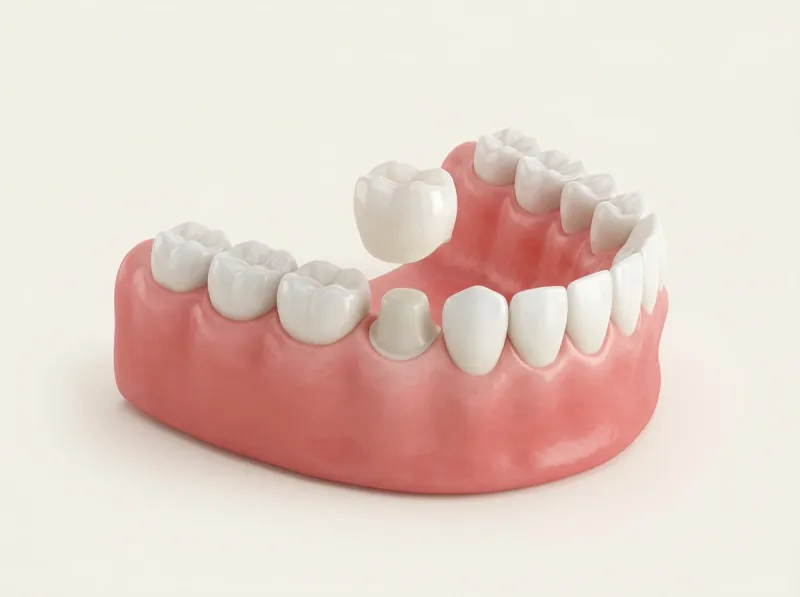
A crown is a cap that covers the whole visible part of a tooth, down to the gum. A dental lab makes it, most often in zirconia or another ceramic, and the dentist fixes it with cement or bonding. Because it wraps around the tooth, it holds weak walls and cracks together every time you bite.
That strength costs tooth. To make room, the dentist shapes the tooth on every side. On model teeth, a crown removed about 63% to 72% of a front tooth and 67.5% to 75.6% of a back tooth, against about 3% to 30% for a veneer (Edelhoff and Sorensen 2002). Shaping can also upset the nerve: in 120 healthy teeth prepared for crowns, the nerve died in 9% (Kontakiotis 2015). So a crown is the right tool for a tooth that is already weak.
Usually a crown
- A cracked tooth that hurts when you bite, or a crack that runs into a filling. Covering the tooth holds the crack together.
- A broken cusp (a corner of a back tooth). An onlay, a partial crown, may be enough.
- A back tooth that is mostly filling. Bigger fillings fail sooner: in 2,816 back-tooth fillings from 12 studies, the more surfaces a filling covered, the higher the risk (Opdam 2014).
- A back tooth after a root canal. Root-filled teeth without a crown were lost 6 times faster than teeth with one (Aquilino and Caplan 2002).
- Teeth badly worn down by grinding or acid. Experts advise the least invasive fix that works, so bonding often comes first (Loomans 2017).
- An old crown with decay at its edge or a large break. A small chip can often be polished instead.
Read more: how much is a root canal and crown together?
Usually something smaller
- Fine lines in the enamel with no pain (craze lines): nothing, or whitening if they show.
- A small crack with no pain and no decay: watch it at check-ups. In a US study of 2,601 cracked back teeth, only 3% broke within 3 years (Hilton 2020).
- Healthy teeth that are stained: whitening. No tooth is removed.
- A small chip or gap: bonding, with little or no tooth removed.
- Healthy front teeth you want to reshape: veneers, which keep far more of the tooth.
Some teeth are past a crown. A tooth split in two, or cracked below the gum line, usually has to come out, and then an implant or a bridge replaces it (American Association of Endodontists).
An exam and an X-ray decide it, tooth by tooth. Send us your X-ray and photos, and we ask the clinic which teeth really need crowns before you book.
Can I have crowns on all my teeth?
Yes, when the teeth need it. Most full sets are 8 to 10 crowns on the upper teeth that show when you smile, or 16 to 20 crowns on the teeth that show top and bottom.
- A full set fits: many teeth worn down by grinding or acid, many large fillings, or old crowns that are failing together.
- A full set does not fit: healthy front teeth that are only stained, chipped or uneven. Whitening or veneers keep much more of your own tooth.
- A mixed plan is common: crowns on the broken or heavily filled teeth, veneers on the healthy front teeth beside them. The same lab makes both at the same time, so the shades match.
What a full set costs
| Crowns | Lowest-priced brand | DD Bio | Highest-priced brand | In Australia |
|---|---|---|---|---|
| 8 | A$1,776 | A$2,664 | A$7,768 | about A$10,000 to A$16,800 |
| 10 | A$2,220 | A$3,330 | A$9,710 | about A$12,500 to A$21,000 |
| 16 | A$3,552 | A$5,328 | A$15,536 | about A$20,000 to A$33,600 |
| 20 | A$4,440 | A$6,660 | A$19,420 | about A$25,000 to A$42,000 |
How it is worked out: the number of crowns times the price per tooth of each brand on our list. The Australian column is the same number of crowns at A$1,250 to A$2,100 each (ADA fee survey 2022, via Choice). For a set of 16 or 20, Orodent Bleach is priced lower per tooth: A$628 instead of A$666.
With return flights from Australia and 7 nights in a hotel, our estimate of about A$1,100 to A$2,000, twenty crowns come to about A$5,500 to A$21,400 in all, depending on the brand.
Read more: how much do crowns cost in Vietnam?
Planning the look of a full set
- Before any tooth is shaped, a full record of your teeth, smile and bite is taken, and the new smile is designed on screen from your scan and photos.
- In the written terms we hold from one partner clinic, the crown price includes this digital design of your new smile.
- When every visible tooth is done, you can choose a lighter shade than your own teeth, because there is nothing left to match. Keep it inside the natural range so it suits your face and gums.
Read more: what is smile design?
The look the press calls Turkey teeth is a full set of crowns on mostly healthy teeth, in one flat, very white shade. A review of 131 UK newspaper articles found that tabloids often shamed people who had dental work abroad (Doughty 2025). The useful lesson is not the country: it is the two choices behind that look, and both can be avoided.
If many teeth are missing or failing
A crown needs a sound root under it. When most teeth are missing, loose from gum disease or past saving, the full-mouth option is a fixed set of teeth on implants (All-on-4 or All-on-6). A full mouth, with All-on-4 on the lower jaw and All-on-6 on the upper, costs about A$19,996 to A$34,507, depending on the brand, over two trips.
What if the tooth is already missing?
A crown needs a tooth under it. When the tooth is gone, there are three usual ways to fill the gap: an implant with a crown on top, a bridge (crowns on the teeth either side holding a false tooth between them), or a denture you take out.
An implant is a titanium post that fuses with your jawbone and replaces the root. The crown is held on it by a small screw and a connecting part (an abutment), both from the implant's own system. In Vietnam one full tooth, implant and crown together, costs A$786 to A$3,102 or more, depending on the brand. It takes two trips, 3 to 6 months apart, because the bone needs that time to heal around the post.
How implant crowns do
- In a review of single crowns on implants, 96.3% of the crowns were still in place after 5 years and 89.4% after 10 years. The implants under them did a little better: 97.2% and 95.2% (Jung 2012).
- The common problems are small: within 5 years, the screw came loose on 8.8% of crowns, the crown came off on 4.1%, and the porcelain chipped on 3.5% (Jung 2012).
- A dentist at home can usually fix these, if they know the implant brand and have its parts. So the brand, system and size go on your records.
An implant crown is either screwed on, so it can be taken off and put back, or cemented on, like a crown on a natural tooth. Ask which one your plan uses.
Which crown material should I choose?
Most crowns today are zirconia or E-max (a glass ceramic). Each can be made as one solid piece, called monolithic, or as a core with porcelain baked on top, called layered. Solid crowns are now the usual choice, and that matters: over 5 years, layered zirconia crowns chipped in 7.9% of cases and solid ones in 0.4% (Pjetursson 2026).
| Material | What it is | Usually suits | What the studies found |
|---|---|---|---|
| Solid zirconia | One piece of zirconia, the strongest option | Back teeth, people who grind, most crowns | 96.8% in place at 5 years; chipped 0.4% (Pjetursson 2026) |
| Layered zirconia | Zirconia core with porcelain baked on the front | Front teeth where light and depth matter | Chipped 7.9% within 5 years (Pjetursson 2026) |
| Solid E-max | Glass ceramic that lets more light through | Front teeth | 98.5% in place at 5 years (Pjetursson 2026); 96.5% at about 10 years (Malament 2019) |
| Metal-ceramic | Porcelain over a metal base | Back teeth where looks matter less | 92.3% front and 95.9% back teeth at 10 years (Behr 2014) |
- Zirconia comes in types. The classic, strongest type lets little light through. Newer translucent types let more through and are less strong (Zhang and Lawn 2018).
- Biting on a back tooth can pass 500 newtons, and every ceramic slowly loses strength under years of chewing (Zhang and Lawn 2018). That is why the strongest material goes where the bite is heaviest.
- Polished zirconia is kind to the tooth it bites on. Over up to 2 years, the opposite tooth lost about 0.04 mm more enamel against solid zirconia than against a natural tooth, and about 0.08 mm more against metal-ceramic (Mao 2024).
- Metal-ceramic can show a dark line at the gum as the gum shrinks back over the years. Zirconia and E-max avoid it.
Read more: zirconia vs E-max crowns
The brands on our list
Our partner clinics in Vietnam use zirconia for crowns. Our list has eight brands in three levels: Standard (Katana, Ceramill, DD Bio), Plus (Origin Beyond Plus, Lava Plus, Lava Esthetic) and Premium (Orodent Bleach, Origin Apex). The lab warranty is the lab's own warranty on the crown.
| Material | Made in | Lab warranty | Price per tooth |
|---|---|---|---|
| Katana | Japan | 7 years | A$222 |
| Ceramill | Austria | 10 years | A$286 |
| DD Bio | Germany | 10 years | A$333 |
| Origin Beyond Plus | USA | 10 years | A$357 |
| Lava Plus | USA | 15 years | A$444 |
| Lava Esthetic | USA | 15 years | A$554 |
| Orodent Bleach | Italy | 19 years | A$666 |
| Origin Apex | USA | 15 years | A$971 |
- DD Bio is a good place to start. The maker rates DD Bio ZX² at 1,150 MPa, a strong figure.
- Katana comes in several discs, from more see-through to very strong, so ask which one the lab uses.
- Lava Esthetic is the one line on our list confirmed as a more see-through grade, good for a front tooth next to natural teeth.
- Orodent Bleach is the whitest, for when every visible tooth is done. Next to natural teeth it can look too white. It has the longest warranty on the list, at 19 years.
- If the tooth underneath is dark, a very see-through crown lets the dark show. The dentist picks a material that hides it.
Paying more buys a longer warranty, a whiter shade or more light passing through, not a more natural look. You do not have to pick one brand for every tooth: many plans use a Standard crown on back teeth and a more see-through crown on a front tooth. Whatever you choose, get the brand written on your plan and your warranty card.
Will my crowns look fake?
Crowns from Vietnam do not have to look fake. The country does not decide the look. The shade you choose, the skill of the lab, and whether the teeth needed crowns in the first place do.
What makes crowns look fake
- Too white: lighter than the teeth beside it. In photos rated by 158 dentists and lay people, a tooth made lighter was noticed at smaller differences than one made darker (Ntovas 2024).
- Too big: too long and too wide for the face.
- All the same: every tooth one shape and one size.
- Flat: solid colour, with none of the see-through edge of a real tooth. Hiding a dark tooth with opaque cement gives this flat, dead look (Dejak 2026).
What the studies say about the look
- Colour matters most to patients. When 200 patients rated their front-tooth restorations, colour was a main factor in how they judged the look (Kristek Zorić 2014).
- Teeth darken with age. In 674 people measured with a shade device, front teeth became darker and more yellow with age (Kim 2018). A shade that suits a 25-year-old can look too white at 55.
- Light is not the problem on its own. In an online survey, about 75% of people preferred the lightest shade shown, when every tooth in the picture had that shade (Almufleh 2020).
- Face shape does not predict tooth shape. One study of 204 people found no link (Wolfart 2004), and in another of 160 people only about 24% matched (Varjão 2006). So ignore square face, square teeth.
- Worn teeth are shorter and squarer (Magne 2003), so very long, even crowns look out of place on an older face.
- The colour of a solid zirconia crown depends on how the zirconia is made, on the lab's work, and on the tooth and cement under it (Tabatabaian 2019). That is why, when we choose a clinic, we also look at the lab it works with.
- The results hold up: solid and layered zirconia crowns scored excellent for looks with patients and dentists over about 6 years (Waldecker 2022), and no zirconia crown in a review of 64 studies was remade for how it looked within 5 years (Pjetursson 2026).
How to get a natural look
- Choose the shade in daylight, away from the dental chair, with a mirror and the shade sample held against your own teeth.
- Whiten your other teeth first. Whitening does not change the colour of a crown, so the crown should match your teeth after whitening (Colgate Australia, citing the Australian Dental Association).
- Stay inside the natural shade range, unless every visible tooth is being done.
- See the shape on screen or as a trial in your mouth before the final crowns are made.
- If a tooth is dark, ask how it will be hidden: from the inside of the crown, not with an opaque cement.
- On fitting day, look at the crowns in daylight before they are fixed. Changing the shade or shape is easy then, and much harder after.
Price and looks: paying more does not buy a natural look. A very white shade and big, identical shapes are what look fake, and no brand fixes that.
How long do crowns last, and what can go wrong?
Crowns last well. In these studies, survival means the crown is still in the mouth and working; one that chipped and was polished, or came loose and was cemented back, still counts.
| Study | Crowns | Still in place |
|---|---|---|
| Pjetursson 2026, review of 64 studies | Solid zirconia | 96.8% at 5 years |
| Pjetursson 2026, review of 64 studies | Solid E-max | 98.5% at 5 years |
| Takaesu 2025, 255 back-tooth crowns, Japan | Solid and layered zirconia | 86.0% solid and 71.0% layered at 10 years |
| Malament 2019, one private practice | Solid pressed E-max | 96.5% at about 10 years |
| Behr 2014 | Metal-ceramic | 92.3% front and 95.9% back teeth at 10 years |
| De Backer 2006 | Full crowns | 78% at 18 years |
| Walton 2013, 2,340 crowns, one Sydney practice | Metal-ceramic | 85.4% at 25 years |
Zirconia is newer, so its long studies are few. It has improved: in a 2015 review of mostly older layered designs, 92.1% of zirconia crowns survived 5 years (Sailer 2015). The Japanese 10-year study was small, so the true figure for solid crowns could be anywhere from about 73% to 99% (Takaesu 2025). Nobody has 20-year numbers for zirconia yet.
Read more: how long do zirconia crowns last?
What goes wrong, and how often
- Decay at the edge: the main cause of failure over the long run (De Backer 2006). In 1,116 crowns and bridges followed for about 7 years, it was found in 4% of people who cleaned well and 18.4% of those who cleaned poorly (Alenezi 2023).
- The nerve: shaping a living tooth can upset it. In a Hong Kong study, 84.4% of teeth under a single crown still had a living nerve after 10 years and 81.2% after 15; the rest needed a root canal (Cheung 2005). This can happen with a crown made anywhere, and removing less tooth lowers the risk.
- Coming loose: 3.0% of solid zirconia crowns within 5 years (Pjetursson 2026). If the crown and tooth are sound, it is cleaned and cemented back.
- Chipping: 0.4% for solid zirconia and 7.9% for layered zirconia within 5 years. A small chip is polished smooth (Pjetursson 2026).
- Breaking through: none of 737 solid zirconia crowns broke within 5 years (Pjetursson 2026).
- Molars: crowns on molars had about 6 times the problems of crowns on premolars (Takaesu 2025).
Your health and habits
- Cleaning at the gum line is the biggest thing you control, as the decay numbers above show.
- Healthy gums come before crowns. If your gums need treatment first, it can add up to 7 days to the trip.
- Grinding: tell the dentist before treatment and ask about a night guard. The evidence is thin; across reviews of zirconia crowns, people who grind were "only examined sporadically" (Laumbacher 2021).
- A bad smell or taste near a crown often means an edge that traps food. A crown that fits tightly at the gum, checked before it is cemented, avoids most of it.
Read more: can crowns and veneers cause bad breath?
Flying home on final crowns rarely causes trouble. Tooth pain from the change of air pressure in a plane has a name, barodontalgia; a review describes it as rare, and it usually points to a problem already in the tooth, such as decay under an old filling (Zadik 2009).
How do I choose a clinic in Vietnam?
The lower price comes mainly from lower operating costs, not lower quality. The zirconia on our list comes from makers in Japan, Austria, Germany, the USA and Italy, the same materials clinics use in Australia.
Vietnam is rated at the lowest level of Australian travel advice. The real difference sits with each clinic and dentist, and good and poor clinics look the same online. Research on dental tourism finds the same gaps again and again: no proper plan, no one to see after treatment, and no follow-up at home. A written plan, a named dentist, named materials and records you take home close most of them.
Read more: is it safe to get dental work in Vietnam?
Ask these before you say yes
- Does this tooth really need a crown, or would a filling, an onlay, bonding or a veneer do?
- How much of my tooth will you shape away, and why?
- Which material and which brand? Will it be written on my warranty card?
- Which lab makes the crowns, and how do you choose the shade?
- Will each crown be cemented or bonded?
- Can I see the shape and colour before the final crowns are made?
- What is the total price in writing, including the check-up, temporary crowns and any root canals?
- What happens if a crown chips or comes loose after I fly home?
Be careful with any plan that crowns a full set of healthy teeth. A clinic that tells you a tooth does not need a crown is a good sign.
How we help
- We check the clinics we work with, and the lab each one uses, and pick the clinic that suits your case.
- We have partner clinics in Hanoi, Ho Chi Minh City and Da Nang, and someone from our team comes to every appointment with you.
- Send us photos of your smile and your X-ray, and we ask these questions for you before you book.
How much will it cost, and is it worth the flight?
A zirconia crown at our partner clinics in Vietnam costs A$222 to A$971 per tooth, depending on the brand (the brand table is in chapter 4). One crown in Australia usually costs A$1,250 to A$2,100 (ADA fee survey 2022, via Choice).
- Included, in the written terms we hold from one partner clinic: the mouth scan, a digital design of your new smile, local anaesthetic, temporary crowns, trying the crowns in, fixing them, bite adjustments and follow-up messages after you go home. Ask for the same list on your own quote.
- Only if your plan needs them: a root canal at A$167 a tooth, and a post and core at A$111.
- The check-up package, with a 3D scan, a full check-up and a clean and polish, is A$28.
- A metal-ceramic crown is also offered for back teeth, where looks matter less. Your quote shows its price next to the zirconia options.
Is it worth the flight?
How this table is worked out: DD Bio crowns at A$333 a tooth plus the A$28 check-up package, then return flights from Australia and 7 nights in a 3 to 4 star hotel, our estimate of about A$1,100 to A$2,000. The Australian side is the same number of crowns at A$1,250 to A$2,100 each.
| Crowns | In Australia | Vietnam treatment | Vietnam with flights and hotel |
|---|---|---|---|
| 1 | A$1,250 to A$2,100 | A$361 | A$1,500 to A$2,400 |
| 2 | A$2,500 to A$4,200 | A$694 | A$1,800 to A$2,700 |
| 3 | A$3,750 to A$6,300 | A$1,027 | A$2,100 to A$3,000 |
| 8 | A$10,000 to A$16,800 | A$2,692 | A$3,800 to A$4,700 |
| 16 | A$20,000 to A$33,600 | A$5,356 | A$6,500 to A$7,400 |
| 20 | A$25,000 to A$42,000 | A$6,688 | A$7,800 to A$8,700 |
- One or two crowns: usually not worth a trip on their own. They make sense if you are already travelling in Vietnam.
- From three crowns: the saving covers flights and a hotel, even against a lower Australian quote.
- From eight crowns: the saving is large enough to stay well ahead even if something needed a second visit.
- If you lose pay for the week away, add that to your own maths. It is part of the real cost.
Read more: is it worth going overseas for dental crowns?
How to pay
A 10 percent deposit confirms your booking, through a secure Stripe card link. You pay the other 90 percent at the clinic on the day of treatment. Before any payment, The Hudson sends the details in writing with a short video confirming them. Wise usually costs less than a normal bank transfer.
- We cannot offer instalments yet. Zip, Humm and Latitude only work with Australian businesses, and Splitit does not work with businesses in Vietnam.
- Some patients take a personal or medical loan at home instead. Compare the interest and fees before you sign.
Insurance and super
- Medicare and Australian private health extras do not pay for dental work done overseas. Your extras still help at home with check-ups, cleans and X-rays before you go and after you return.
- Medical travel insurance for planned treatment can pay for a longer stay or a trip back if a complication needs correcting, but not for the treatment itself.
- Releasing super early for dental work is hard: the ATO only allows it for a serious condition when you have no other way to pay, and cosmetic work does not qualify.
Read more: does health insurance cover dental work overseas?
What happens in the 7 days?
Crowns on your own teeth need no bone to heal, so the whole job fits in one trip of up to 7 days. The dental work itself takes 3 to 4 days. The rest is rest, and a few days living with your new teeth before you fly.
| Day | What happens |
|---|---|
| Day 0 | You land, we pick you up at the airport, and you sleep. |
| Day 1, morning | Check-up, a 3D scan, X-rays and a bite check. The dentist confirms the plan, you get the prices in writing, and you decide. Your shade is chosen in daylight. |
| Day 1, afternoon | A full record of your teeth and bite is taken first. Then your teeth are shaped under local anaesthetic and temporary crowns go on, in about 1 to 2 hours depending on how many teeth. |
| Days 2 and 3 | The lab in Vietnam makes your crowns, usually in 2 days. You are free. |
| Day 3 or 4 | Fitting day. Each crown is tried in, adjusted and tried again until it fits and the bite is even, then fixed and polished. You get your records and the lab warranty card. |
| Days 5 and 6 | You live with your new teeth. If something catches or feels high at meals, the dentist adjusts it. |
| Day 7 | You fly home. |
When the trip changes
- A full set of 16 to 20 crowns: the same days, with longer appointments. One of our partner clinics plans about 4 to 6 hours on the first day and 4 to 5 hours on fitting day.
- A tooth needs a root canal first: up to 7 more days, so the root canal is done and checked before the crown is made.
- Gums need treatment first: up to 7 more days.
- Old crowns to replace: keep 1 or 2 spare days, because the dentist only sees the tooth once the old crown is off.
- Crowns and veneers together: usually the same week. Veneers add a trial smile before the teeth are shaped.
- A crown on an implant: two trips, months apart.
Read more: how many days do I need for crowns in Vietnam?
Living with temporary crowns
- Temporary crowns are made from a tooth-coloured resin. They look and feel like normal teeth, and you can eat with them.
- Avoid very sticky food such as toffee and very hard food such as ice, because temporaries are held on with a softer cement.
- When you floss, slide the floss out sideways instead of pulling it up.
- Some teeth feel sensitive to hot and cold for a few days after shaping. This usually settles on its own.
- Stay within reach of the clinic. If a temporary comes loose, the dentist puts it back in a few minutes.
Fitting day
This is the moment to speak up. Look at the shade and shape in daylight, bite on each side, and say if anything feels high or rough. A crown that sits too high takes too much force at every bite, and changing it is easy before the cement goes on.
Fly home on your final crowns, not on temporaries. One of our partner clinics says flying is fine 24 hours after the crowns are fixed. We plan a few days between fitting and flying so there is time to adjust anything that feels off at meals.
What happens when I get home?
Looking after your crowns
- Brush twice a day with a soft toothbrush and a non-abrasive toothpaste, paying attention to the gum line.
- Clean between your teeth every day, with floss or small brushes.
- Avoid biting ice, hard nuts, bottle caps or fingernails, and do not open packaging with your teeth.
- If you grind your teeth, wear the night guard your dentist advises.
- See your local dentist for a check-up after 6 to 12 months, then as they advise.
If something goes wrong
- Bite feels high: a local dentist can usually adjust it in minutes.
- Sensitivity to cold: usually better in one or two weeks. If it lasts or gets worse, get it checked.
- A crown feels loose: see a dentist soon. A crown cemented back early is a small job; one left loose lets decay in.
- A small chip: often polished or repaired at home.
- A root canal later: a shaped tooth's nerve can die months or years on, as the studies in chapter 6 show. It is treated through the crown or with a new crown.
Will a dentist at home help? Usually yes for simple crown problems: cementing a crown back on, adjusting the bite, a small repair or a new crown are normal work for a general dentist. The Australian Dental Association's policy statement on overseas treatment (2023) notes that records from overseas may not be available. Your paperwork closes that gap.
Read more: will an Australian dentist fix dental work done overseas?
What to keep
- The written treatment plan, with the crown material on each tooth.
- The lab warranty card, which shows the brand and the warranty years.
- Your X-rays and scans.
Contact The Hudson first, with a photo if you can. We speak with the clinic if needed and tell you the next step. Each clinic has its own aftercare policy, so before treatment we pick the clinic whose aftercare suits your case and agree it with them in writing.
If you need an in-person check, we can point you to a local dentist. In Australia, we can book you in with one of our partner clinics and send your records ahead. Once a year for 10 years, you can send us photos of your teeth and your yearly X-ray. We look at them for free, and you get a 15-minute call with Hudson, the founder of The Hudson.
Read more: what happens if my dental work fails after I fly home?
Sources
- Pjetursson BE et al. Survival, failure and complication rates of metal-ceramic, veneered and monolithic all-ceramic tooth-supported single crowns, part 1. International Journal of Prosthodontics, 2026. 64 studies. 5-year survival, chipping and loosening by material.
- Sailer I et al. All-ceramic or metal-ceramic single crowns, systematic review. Dental Materials, 2015. 92.1% of zirconia crowns, mostly older layered designs, at 5 years.
- Takaesu Y et al. Long-term clinical outcomes of posterior monolithic and porcelain-fused zirconia crowns. Journal of Prosthetic Dentistry, 2025. 255 back-tooth crowns, up to 10 years.
- Malament KA et al. 10-year results of pressed lithium disilicate restorations. Journal of Prosthetic Dentistry, 2019. 96.5% of solid E-max crowns at about 10 years.
- Waldecker M et al. Five-year clinical performance of monolithic and partially veneered zirconia single crowns. Journal of Prosthodontic Research, 2022. 93.1% of solid zirconia crowns at 5 years; looks rated excellent.
- Behr M et al. Precious-alloy metal-ceramic single crowns. International Journal of Prosthodontics, 2014. 10-year survival, 92.3% front and 95.9% back teeth.
- De Backer H et al. 18-year survival of full crowns. International Journal of Prosthodontics, 2006. 78% at 18 years; decay at the edge as the main cause of failure.
- Walton TR. Up to 25-year survival of 2,340 metal-ceramic crowns. International Journal of Prosthodontics, 2013. 85.4% at 25 years, one Sydney practice.
- Laumbacher H et al. Long-term clinical performance and complications of zirconia-based restorations: a summary of systematic reviews. Journal of Dentistry, 2021. Chipping the most common technical problem; grinding rarely studied.
- Alenezi A et al. Secondary caries in fixed dental prostheses: long-term clinical evaluation. Clinical and Experimental Dental Research, 2023. 1,116 crowns and bridges, about 7 years. Decay at the edge by cleaning.
- Kontakiotis EG et al. Incidence of asymptomatic pulp necrosis following crown preparation. International Endodontic Journal, 2015. 120 teeth; the nerve died in 9%.
- Cheung GSP, Lai SCN, Ng RPY. Fate of vital pulps beneath a metal-ceramic crown or a bridge retainer. International Endodontic Journal, 2005. 84.4% of nerves alive at 10 years, 81.2% at 15.
- Edelhoff D, Sorensen JA. Tooth structure removal for anterior preparation designs. Journal of Prosthetic Dentistry, 2002. A crown removes about 63% to 72% of a front tooth; a veneer about 3% to 30%.
- Edelhoff D, Sorensen JA. Tooth structure removal for posterior preparation designs. International Journal of Periodontics and Restorative Dentistry, 2002. 67.5% to 75.6% of a back tooth.
- Hilton TJ et al. Baseline characteristics as 3-year predictors of tooth fracture and crack progression. Journal of the American Dental Association, published online 2020. 3% of cracked back teeth broke within 3 years.
- Opdam NJM et al. Longevity of posterior composite restorations. Journal of Dental Research, 2014. 2,816 fillings; bigger fillings fail sooner.
- Aquilino SA, Caplan DJ. Crown placement and the survival of endodontically treated teeth. Journal of Prosthetic Dentistry, 2002. Root-filled teeth without a crown lost 6 times faster.
- Loomans B et al. Severe tooth wear: European consensus statement on management guidelines. Journal of Adhesive Dentistry, 2017.
- American Association of Endodontists. Cracked teeth, patient guide.
- Jung RE et al. Single crowns on implants with a mean follow-up of 5 years, systematic review. Clinical Oral Implants Research, 2012. 96.3% of implant crowns at 5 years, 89.4% at 10; screw loosening 8.8%.
- Zhang Y, Lawn BR. Novel zirconia materials in dentistry. Journal of Dental Research, 2018. Translucent zirconia is less strong; back-tooth biting can pass 500 newtons.
- Mao Z et al. Opposing-tooth wear by crown material, network meta-analysis. Journal of Dentistry, 2024.
- Kristek Zorić E, Žagar M, Knezović Zlatarić D. Influence of gender on the patient's assessment of restorations on the upper anterior teeth. Acta Stomatologica Croatica, 2014. 200 patients rated colour a main factor in how they look.
- Ntovas P et al. Perceptibility and acceptability of lightness difference of a single maxillary central incisor. Journal of Esthetic and Restorative Dentistry, 2024. 158 observers. A tooth made lighter is noticed sooner than one made darker.
- Kim HK. Color distribution of natural teeth by age and gender. Journal of Esthetic and Restorative Dentistry, 2018. 674 people; teeth darken and yellow with age.
- Almufleh B et al. Tooth shade preferences among the general public. Journal of Prosthodontics, 2020.
- Wolfart S, Menzel H, Kern M. Inability to relate tooth forms to face forms. European Journal of Oral Sciences, 2004. 204 people, no link between face and tooth shape.
- Varjão FM et al. Face form and maxillary central incisor form. Quintessence International, 2006. 160 people, about 24% matched.
- Magne P, Gallucci GO, Belser UC. Dimensions of maxillary anterior teeth. Journal of Prosthetic Dentistry, 2003. Worn teeth are shorter and squarer.
- Tabatabaian F. Color aspect of monolithic zirconia restorations: a review of the literature. Journal of Prosthodontics, 2019. 192 articles; colour depends on the zirconia, the lab, the tooth and the cement.
- Dejak B et al. Prosthetic substrate, cement and opaquer liner and the colour of translucent zirconia and lithium-based ceramics. Materials, 2026. Opaque cement gave a loss of optical depth.
- Doughty J et al. Contemporary dental tourism: a review of reporting in the UK news media. British Dental Journal, 2025. 131 UK newspaper articles.
- Colgate Australia. Can you whiten a crown? (citing the Australian Dental Association).
- Zadik Y. Barodontalgia. Journal of Endodontics, 2009. Tooth pain from air pressure on a plane is rare and points to a problem already in the tooth.
- Australian Dental Association. Policy Statement 2.2.6, Elective Overseas Dental Treatment (amended November 2023).
- Smartraveller (Australian Government). Vietnam travel advice. Vietnam at the lowest advice level.
- Orodent. Zirconia Bleach, maker's page. The maker's own description of this very white line.
- Solventum. Lava Esthetic zirconia, maker's page.
- Dental Direkt. DD Bio ZX², maker's page. 1,150 MPa, the maker's figure.
- Kuraray Noritake. Katana zirconia range, maker's page. Several discs, from more see-through to very strong.
- ADA fee survey 2022, via Choice. Australian crown fees.
- The Hudson price list, November 2026 (partner clinics in Vietnam). Travel: The Hudson estimates for return flights from Australia and a 3 to 4 star hotel for 7 nights.
Figures come from the sources above, checked on 9 November 2026. Our prices come from our price list and can change; the clinic confirms your price after it has seen your scan. The Hudson plans and coordinates treatment at partner clinics in Vietnam; we are not a clinic. This is general information, not advice for your own mouth. About the author.