Will crowns from Vietnam look fake?
Crowns from Vietnam do not have to look fake. Crowns look fake when they are too white, all the same size and shape, and when light cannot pass through them the way it passes through a real tooth. The country does not decide this; the shade you choose, the skill of the lab, and whether you needed crowns in the first place do.
Fake-looking and natural-looking crowns at a glance
| What makes crowns look fake | What makes them look natural |
|---|---|
| One very white shade that matches nothing around it | A shade chosen in daylight, against your own teeth and skin |
| Every tooth the same size and shape | Each tooth shaped like its own kind: front teeth, side teeth and canines differ |
| A flat, solid look with no see-through edge | A little translucency at the biting edge, and a surface the lab has stained and glazed |
| Teeth too big or too straight for the face | Sizes planned to your lips and face, often with a trial smile first |
| A dark tooth showing through, or hidden with an opaque cement | The dark colour hidden from the inside, so the surface keeps its depth |
| Healthy teeth cut down to stumps | Crowns only on teeth that need them |
None of these depends on the country. Each one is a choice made by you, the dentist or the lab. The sections below show what the research says about each, and what to ask.
What are "Turkey teeth"?
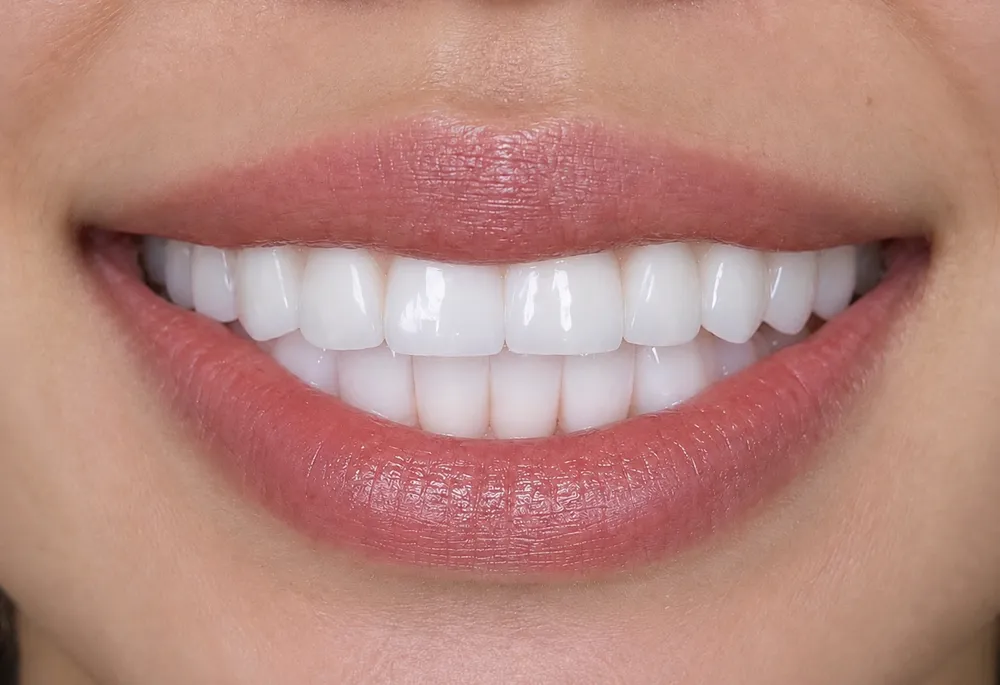
"Turkey teeth" is a nickname, not a dental term. It means a smile where healthy teeth were filed down and covered with crowns that are very white and all the same shape. It became famous because many people travelled to Turkey for it, but it can happen in any country, including Vietnam and Australia.
Two things cause it:
- Healthy teeth are cut down for crowns, when veneers, whitening or nothing at all would have been enough.
- The crowns are made in a very bright white shade, in one uniform shape, so they look like a row of piano keys.
The name spread through social media and the UK press. A review of 131 UK newspaper articles found that tabloids often shamed people who had dental work abroad (Doughty 2025). The useful lesson is not the country. It is the two choices above, and both can be avoided.
Why do some crowns look fake?
Crowns look fake for three main reasons:
- The shade is too white. Real teeth are not pure white; they change in colour from the edge to the gum.
- The shape is too uniform. Your front teeth, the teeth next to them and your canines all have different sizes and shapes. Crowns that are all the same look artificial.
- Light cannot pass through. Real enamel lets some light through at the surface and the biting edge. A crown that blocks all light looks flat and "plastic".
No study ranks these causes against each other. Our reading of the separate studies is that shade comes first for one crown, and shade plus shape for a full set.
What the research says about shade
- Colour matters most to patients. When 200 patients rated their front-tooth restorations, colour was a significant factor in how they judged the look (Zorić 2014).
- People notice small differences. When 158 dentists and lay people looked at photos where one front tooth was made lighter or darker, even small changes were seen, and a tooth made lighter was noticed at smaller differences than one made darker (Ntovas 2024). One crown whiter than its neighbours stands out.
- Natural teeth darken with age. In 674 people measured with a shade device, front teeth became darker and more yellow with age (Kim 2018). A shade that suits a 25-year-old can look too white in a 55-year-old mouth.
- White is not the problem on its own. In an online survey, about 75% of people preferred the lightest tooth shade shown, when every tooth in the picture had that shade (Almufleh 2020). A light smile can look good. What looks fake is one flat white that does not match the teeth, the gums or the face around it.
How much light should a crown let through?
Real enamel is slightly see-through, most of all at the biting edge. Crowns copy this in different ways:
- Zirconia comes in types. The classic, strongest type lets little light through. Newer translucent types let more through and are less strong (Zhang and Lawn 2018).
- Multilayer zirconia blocks run from a more see-through edge to a more coloured neck, the way a real tooth does, so one crown gets some of both.
- E-max (a glass ceramic) lets more light through than zirconia (Dejak 2026). Our partner clinics in Vietnam use it for veneers, and zirconia for crowns.
- On our list, Lava Esthetic is a translucent multilayer zirconia made for front teeth. Orodent Bleach buys a whiter shade, not more translucency.
Translucency matters most on a front tooth next to your own natural teeth. On back teeth, which barely show, strength matters more than how much light passes through.
What if the tooth underneath is dark?
A tooth that has had a root canal can turn grey, and a metal post shows through a thin, see-through crown. The colour underneath changes the final colour of the crown (Dejak 2026). How it is hidden decides whether the crown looks alive or dead:
- Hide it from the inside. The dentist can cover the dark tooth with a tooth-coloured opaque layer, or the lab can line the inside of the crown, so the outer surface stays see-through.
- For a dark root-filled front tooth, the dentist may whiten it from the inside before the crown.
- Avoid hiding it with an opaque cement on a front tooth. In a lab study, opaque cement under translucent crowns gave colour errors beyond what is clinically acceptable and a "loss of optical depth" (Dejak 2026). That is the flat, dead look.
- A more opaque zirconia, or a thicker crown, hides a dark tooth better. It suits a back tooth well. On a front tooth, the lab balances it with stains and a see-through edge.
What makes a crown look natural?
The shade comes first, then the shape and how the lab finishes the crown. A review of 192 articles on solid zirconia crowns found that their colour depends on how the zirconia is made, on the lab's work, and on the tooth and the cement underneath (Tabatabaian 2019). That is why, when we choose a clinic, we also look at the lab it works with. Paying more does not buy a natural look. A very white shade and big, identical shapes are what look fake, and no brand fixes that.
The clinical results are reassuring. In a German study, solid zirconia crowns and zirconia crowns with a thin porcelain layer on the front both scored excellent for looks with patients and dentists over about 6 years (Waldecker 2022). And in a 2026 review of 64 studies, no solid or layered zirconia crown had to be remade because of how it looked within 5 years (Pjetursson 2026).
To keep your crowns natural:
- Choose the shade with your dentist, in daylight, away from the bright chair light, and compare it with your own teeth and skin tone in a mirror.
- Do not choose the whitest shade just because it is the whitest. Orodent Bleach is the whitest on our list, for when all your visible teeth are being done. Next to your own natural teeth, it can look too white.
- Ask for different shapes for different teeth, not one shape copied across your smile.
- Ask whether your crowns can have a slightly more see-through biting edge and a slightly warmer colour near the gum, like a real tooth.
- For a front tooth, ask about a more see-through material, such as Lava Esthetic. If the tooth underneath is dark, the dentist may choose a less see-through one to hide it.
- Whiten your own teeth first, if you want them lighter, then match the crowns. Whitening does not change the colour of a crown (Australian Dental Association, via Colgate).
Which crown for which tooth?
| Your situation | Usual choice | Why |
|---|---|---|
| One front crown next to your own teeth | A translucent zirconia such as Lava Esthetic | It has to copy the light in the tooth beside it |
| All your visible front teeth | Any brand on the list, in a natural shade | The shade and shapes decide the look, not the brand |
| A very white smile on every tooth | Orodent Bleach or a bleach shade | Only when no natural tooth sits beside it |
| A dark tooth or a metal post | A more opaque zirconia, hidden from the inside | Stops the grey showing through |
| Back teeth | A strong Standard level zirconia | They barely show, and the bite is heaviest |
| Healthy front teeth you want to look better | Whitening, bonding or veneers first | They keep much more of your own tooth |
How do I check the look before the crowns are fixed?
Crowns are tried in before they are fixed. This is the moment to speak up, because changing the shade or shape is easy before the cement goes on and much harder after.
- Look in a hand mirror by a window, not only under the chair light.
- Smile, talk and laugh. Check that the edges follow your lower lip, and that the teeth are not too long or too square for your face.
- Check the colour against your own teeth beside the crowns, and near the gum.
- Take a photo on your phone. A photo shows things a mirror can miss.
- If something looks wrong, say so. The lab can change the shape, shade or surface before the crowns are fixed.
Do I really need crowns?
A crown is the right fix for a tooth that is broken, heavily filled, or has had a root canal. For a healthy tooth, it is a big step. Preparing a front tooth for a crown removes about 63% to 72% of the visible tooth, compared with about 3% to 30% for a veneer. On a back tooth, a crown removes about 67.5% to 75.6% (Edelhoff and Sorensen 2002, measured on model teeth). That tooth structure never grows back, and the crown will need replacing one day.
Many people ask for crowns on healthy teeth to get a prettier smile, and some clinics will do it. If your teeth are healthy, you should hear the other options first: whitening, bonding, or veneers, which remove much less tooth.
Veneers have their own trade-off. They keep more of your tooth, but a veneer can come loose, which is less convenient when your dentist is in another country. If that happens after you fly home, a local dentist can usually bond it back on.
If your teeth are healthy, we show you the less invasive options first, and tell you honestly what a crown will cost your tooth. Then you decide.
Why do dentists push for crowns?
A good dentist recommends a crown when a tooth is too damaged to hold a filling. But a crown also costs much more than a filling, so it is fair to ask why. If a dentist recommends crowns, ask for the reason for each tooth in writing, and get a second opinion if the teeth look healthy to you.
What to ask before your crowns are made
- Why does each tooth need a crown? Could any of them have a veneer, a filling or nothing?
- Which brand and type of zirconia for each tooth, and why?
- Will I choose the shade in daylight, before any tooth is shaped?
- Can I see a trial smile or a digital design of the new teeth first?
- Will the shapes differ from tooth to tooth?
- If a tooth is dark, how will you hide it: from the inside, or with the cement?
- When will I see the crowns tried in, and can they still be changed then?
Common beliefs that are not quite right
- "Crowns from Vietnam look fake." The look comes from the shade, the shapes and the lab's finish. The zirconia brands at our partner clinics in Vietnam are made in Japan, Germany, Austria, the USA and Italy.
- "The whitest shade looks the most natural." Natural teeth darken with age. One crown whiter than its neighbours is noticed at very small differences.
- "A dearer crown will look more natural." The shade, the shape and the lab's finish decide the look. Paying more mostly buys a longer warranty or a whiter shade.
- "Zirconia always looks opaque." Translucent and multilayer zirconias let light through at the edge, and solid zirconia crowns scored excellent for looks in clinical follow-up.
- "I can whiten my crowns later." Whitening does not change the colour of a crown. Whiten first, then match.
What we see in Vietnam
DD Bio zirconia from Germany is a good place to start, and Katana from Japan costs the least. The patients who are happiest with the result are the ones who chose a shade that matches their own face, not the whitest one on the chart. Someone from our team is in the room when the shade is chosen and when the crowns are tried in, so you have a second pair of eyes before anything is fixed.
Quick answers
Can you get crowns that do not look fake?
Yes. Choose a natural shade in daylight, different shapes for different teeth, a translucent material for a single front tooth, and a clinic that works with an experienced lab.
What are the alternatives to Turkey teeth?
For healthy teeth: whitening, bonding, or veneers, which remove much less tooth than crowns. Crowns are kept for teeth that are damaged.
How can you tell if someone has Turkey teeth?
The teeth are very white, all the same size and shape, and often look slightly too big or too straight for the face.
Do zirconia crowns look natural?
They can. Solid zirconia crowns scored excellent for looks with patients and dentists over about 6 years in a German study. The shade, shape and lab finish decide the result.
Can a crown be changed if I do not like the colour?
Before it is fixed, yes: say so at the try-in, and the lab can change it. After it is fixed, it usually has to be cut off and remade.
Worried your quote includes crowns you do not need?
Send us your quote or your photos. We will tell you honestly which teeth need crowns and which may not. Free.
Send my quoteSources
- Edelhoff D, Sorensen JA. Tooth structure removal associated with various preparation designs for anterior teeth. J Prosthet Dent, 2002.
- Edelhoff D, Sorensen JA. Tooth structure removal associated with various preparation designs for posterior teeth. Int J Periodontics Restorative Dent, 2002.
- Doughty J et al. Contemporary dental tourism: a review of reporting in the UK news media. Br Dent J, 2025.
- Zorić EK et al. Influence of gender on the patient's assessment of restorations on the upper anterior teeth. Acta Stomatol Croat, 2014.
- Ntovas P et al. Perceptibility and acceptability of lightness difference of a single maxillary central incisor. J Esthet Restor Dent, 2024.
- Kim HK. A study on the color distribution of natural teeth by age and gender in the Korean population with an intraoral spectrophotometer. J Esthet Restor Dent, 2018.
- Almufleh B et al. Tooth shade preferences among the general public. J Prosthodont, 2020.
- Zhang Y, Lawn BR. Novel zirconia materials in dentistry. J Dent Res, 2018.
- Dejak B et al. Influence of prosthetic substrate, cement, and opaquer liner on color matching of translucent zirconia- and lithium-based ceramics. Materials, 2026.
- Tabatabaian F. Color aspect of monolithic zirconia restorations: a review of the literature. J Prosthodont, 2019.
- Waldecker M et al. Five-year clinical performance of monolithic and partially veneered zirconia single crowns: a prospective observational study. J Prosthodont Res, 2022.
- Pjetursson BE et al. Survival, failure and complication rates of metal-ceramic, veneered and monolithic all-ceramic tooth-supported single crowns, part 1. Int J Prosthodont, 2026.
- Colgate Australia. Can you whiten a crown? (citing the Australian Dental Association).
- Orodent: Zirconia Bleach.